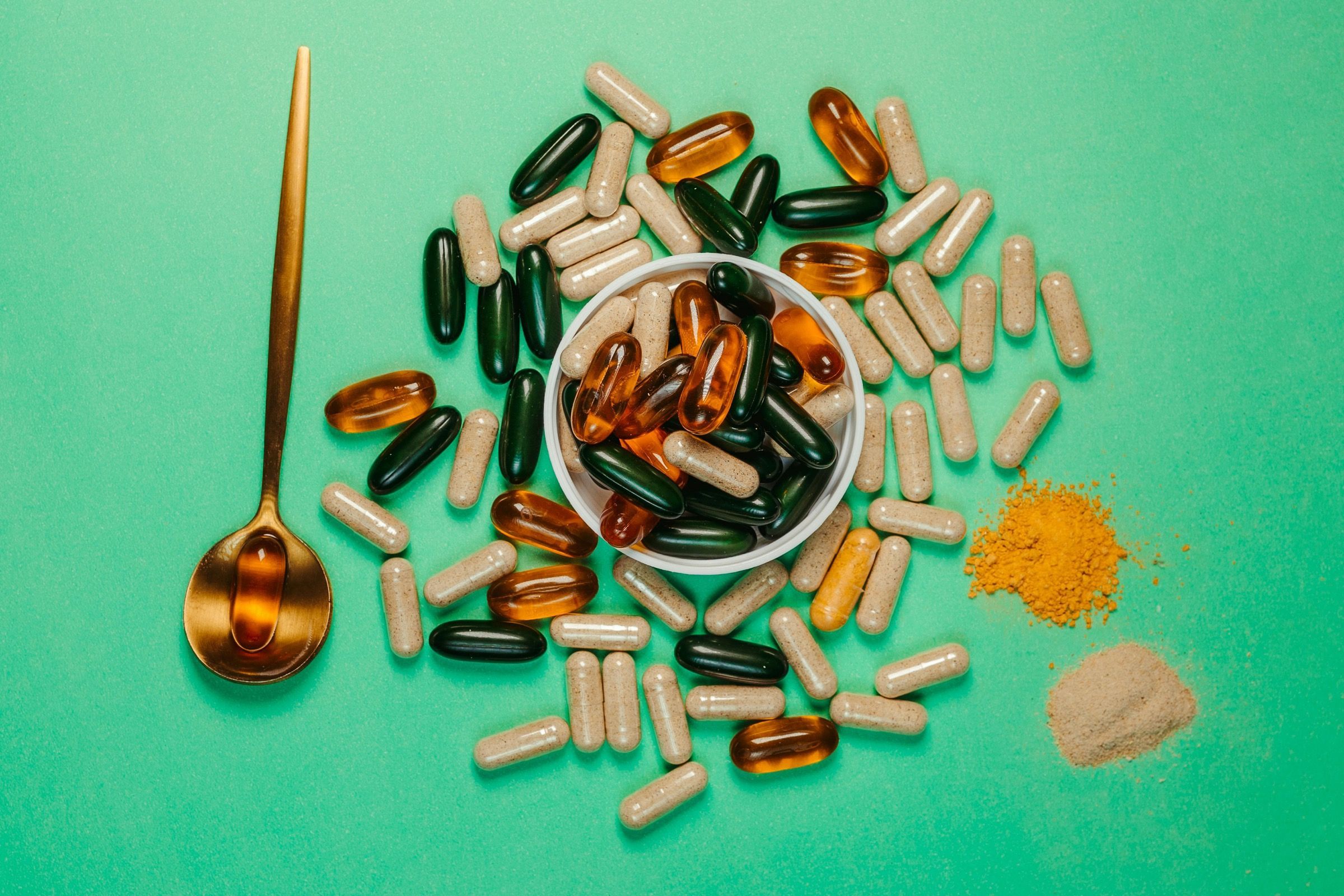
TL;DR: Most supplements are unnecessary. Five cover the vast majority of people: Vitamin D3 with K2, Omega 3, Magnesium, Vitamin B12 (for plant-based diets) and Creatine. Total cost: 30–60 USD per month. Everything else is marketing – until your blood values say otherwise.
Why most supplements are unnecessary
Most supplements are unnecessary for well-nourished adults because there is no confirmed deficiency. Large trials like VITAL show no mortality benefit from multivitamins. Targeted supplementation makes measurable sense only when blood values document a specific deficit.
The global supplement market is worth over 180 billion USD. But the research is sobering: most products offer no measurable benefit to healthy people. The large VITAL study with more than 25 000 participants showed that a daily multivitamin doesn’t reduce overall mortality. Antioxidant capsules have also disappointed in major meta-analyses.
The core problem: supplements are sold as health insurance without anyone checking the actual need. You take 25 capsules a day, but not a single blood value is worse in the person who takes nothing. On top of that, you get interactions, poor bioavailability and contamination – especially in cheap products.
What actually works: a few well-chosen supplements with a concrete goal. You supplement because your blood value sits below the optimal range – not because a podcaster recommended it. Your ferritin is 22 ng/ml, so you take iron. Your 25-OH-D is 18 ng/ml, so you take D3. That’s the whole trick.
The 5 basic supplements worth taking
These five products cover the most common gaps. They’re well researched, safe at standard doses and cheap.
| Supplement | Effect | Dose | Who needs it |
|---|---|---|---|
| Vitamin D3 + K2 | Bones, immune system, mood | 1000–2000 IU D3 + 100 µg K2 (MK-7) daily | Almost everyone in winter; higher if 25-OH-D is below 30 ng/ml |
| Omega 3 (EPA/DHA) | Reduces inflammation, heart, brain | 1–2 g EPA+DHA daily | Anyone eating fatty fish less than twice a week |
| Magnesium (Glycinate/Citrate) | Sleep, muscles, stress resilience | 300–400 mg elemental daily | Under stress, doing sports, with cramps or poor sleep |
| Vitamin B12 (Methylcobalamin) | Blood, nerves, energy | 250–500 µg daily | Vegetarians, vegans, people over 50, anyone on acid blockers |
| Creatine Monohydrate | Strength, cognition, sarcopenia protection | 3–5 g daily (no loading phase needed) | Almost everyone – not just athletes. Also for cognition and aging |
Important details: Creatine is the most researched sports supplement in the world, with over 1000 studies. It supports strength and muscle mass, but also cognitive function in older adults and during sleep deprivation. You only need the cheap monohydrate form – skip the expensive HCL or ethyl ester variants.
Vitamin B12 is not optional for vegans. Without supplementation you develop measurable deficiency within 2–5 years, which can cause nerve damage. People over 50 also absorb B12 poorly because stomach acid decreases with age.
What you don’t need
These products show up in almost every beginner stack – and they’re usually a waste of money.
Multivitamins. They contain 20–30 micronutrients in average doses. The problem: you don’t have an average deficiency, you have two or three specific gaps. A multi doesn’t fill those reliably but does deliver nutrients you already have enough of. Studies show no health benefit in well-nourished adults.
Fat burners and thermogenics. Almost all are based on caffeine, green tea extract or synephrine. The effect on resting metabolism is tiny (100–150 kcal per day at most) and fades within weeks due to tolerance. Meanwhile they stress the heart and sleep. A 300 kcal deficit through mindful eating is cheaper and more effective.
Detox teas and “cleanses.” Your liver and kidneys detoxify 24 hours a day – that’s their job. Detox products mostly contain mild laxatives or diuretics that flush water and drop the scale short term. No study shows that a “gut cleanse” measurably reduces toxins. The effect is purely cosmetic.
BCAAs (branched-chain amino acids). If you eat enough protein (1.6–2 g per kg body weight), you already get all BCAAs from your meals. Isolated BCAA powder adds nothing, as a 2017 meta-analysis made clear. Save the 20–30 USD per month and eat an extra egg instead.
How to find out if you need a supplement
The rule: measure first, supplement second. Without a baseline you have no way to know whether a product works.
A useful basic blood panel costs 50–150 USD and includes:
- 25-OH Vitamin D – target 40–60 ng/ml
- Ferritin – target 50–150 ng/ml for women, 80–200 for men
- Holo-Transcobalamin (active B12) – above 50 pmol/L
- Whole-blood Magnesium (not serum) – in the upper reference range
- Lipid panel including hsCRP and triglycerides
If your ferritin is 18 ng/ml, iron makes sense. If it’s 80, you don’t need iron – no matter how tired you feel. That’s the difference between data-driven optimization and marketing obedience.
A deeper guide on interpreting blood values and tracking trends lives in the article Understanding Blood Values. For a clean before/after measurement, see the Biomarker Baseline Checklist.
How to spot quality – the 5-point check
Not every product with a nice label is trustworthy. Run every new purchase through these five criteria:
- Certificate of Analysis (COA) – The manufacturer publishes a lab certificate per batch confirming active content and purity. No COA, no purchase.
- Active form stated exactly – “Magnesium Bisglycinate” beats “Magnesium”. The form determines bioavailability: Magnesium Oxide is only around 4 % absorbed, Bisglycinate about 80 %.
- No proprietary blends – Blends hide individual doses behind a total. Serious manufacturers list each ingredient with its exact amount.
- Clean excipients – No titanium dioxide (banned as a food additive in the EU since 2022), no sucralose, no artificial colors. Magnesium stearate in small amounts is fine.
- Company address and GMP certification – Country of manufacture, full address and a GMP (Good Manufacturing Practice) certificate should all be publicly visible.
For a deeper audit path with a rating scale, see the Supplement Quality Audit.
Tracking and iteration
You don’t take supplements blindly and forever. You set a goal, measure a baseline, supplement for 8–12 weeks and retest. That’s the difference between a data-driven routine and a pile of pills fueled by hope.
A simple rhythm for beginners:
- Week 0: Blood test. Define goals (e.g. raise 25-OH-D to 50 ng/ml).
- Weeks 1–12: Take the basic five, log doses, keep compliance above 80 %.
- Week 12: Retest. Compare values.
- Decision: Goal hit → maintenance dose. Goal missed → adjust dose or check product quality.
Every supplement needs a target biomarker. No target, no place in the stack. Reviewing your stack every 90 days prevents sprawl and saves money. The full approach lives in Supplement Stack Iteration.
Over years, long-term biomarker tracking pays off because real trends only show up across multiple tests. If you want to adjust your routine by season (more Vitamin D in winter, less in summer), the Cyclic Routine Playbook gives you the structure.
In Lab2go you track blood values, doses and symptom scores in one place. You see the link between your stack and your biomarkers without Excel chaos. Pricing starts with a free tier, and you can switch between levels anytime.
Bottom line
You don’t need a cabinet full of supplements to stay healthy. Five products, precisely dosed and backed by blood values, do more than a shelf full of capsules. The biggest lever isn’t a new powder – it’s cutting out everything you don’t need.
Start like this today: book a blood test, order only the basics that match your values, and retest in 12 weeks. The rest is patience and documentation.
Before starting any supplementation, a blood test is recommended. If you have chronic conditions or take medication, talk to your doctor first.
Article FAQ
- Which supplements are actually worth taking as a beginner?
- Five basic supplements cover most beginners: Vitamin D3 with K2 (1000–2000 IU daily), Omega 3 (1–2 g EPA+DHA daily), Magnesium Glycinate or Citrate (300–400 mg daily), Vitamin B12 (250–500 µg for plant-based diets) and Creatine Monohydrate (3–5 g daily). Everything beyond that is usually unnecessary or counterproductive. Test your blood values before going higher.
- Do I need a multivitamin?
- No. Multivitamins contain dozens of micronutrients in low doses you probably don't need. It makes more sense to supplement the two or three nutrients you actually lack in targeted, higher doses. Multis create a false sense of completeness that blood values don't confirm.
- How much Vitamin D should I take?
- A maintenance dose of 1000–2000 IU daily in winter is enough for most people. With a documented deficiency (25-OH Vitamin D below 20 ng/ml), 4000–5000 IU for 8–12 weeks followed by a lower maintenance dose works well. Always combine D3 with K2 (MK-7, around 100 µg) so the absorbed calcium goes into bones, not arteries. Retest after 12 weeks.
- Which brands are trustworthy?
- Reputable manufacturers publish a Certificate of Analysis (COA) per batch, state the exact active form (e.g., Magnesium Bisglycinate, not just Magnesium), and avoid proprietary blends. Well-known examples: Thorne, Pure Encapsulations, Life Extension, NOW Foods (premium lines), Sunday Natural (EU). Cheap drugstore products often contain poorly bioavailable forms like magnesium oxide, which your body barely absorbs.
- Can I just combine supplements freely?
- The basic five are generally compatible, but a few rules help. Take magnesium in the evening, not with calcium. Vitamin D3 and Omega 3 go with a fatty meal – otherwise absorption drops by up to 50 %. Never take iron with coffee, tea or calcium – they block uptake. If you're on medication (blood thinners, thyroid hormones), check with your doctor first.
- When will I see results?
- It depends on the supplement. Creatine shows early effects on strength and performance within 2–4 weeks. Magnesium often improves stress and sleep in 1–2 weeks. Vitamin D needs 8–12 weeks for blood levels to stabilize. Omega 3 lowers hsCRP and triglycerides after about 12 weeks. If you see no measurable change after 12 weeks, check dosage, product quality and timing.
- Should I test my blood values first?
- Yes, absolutely. Without a baseline you don't know whether you have a deficiency in the first place, and you can't measure success later. The minimum panel: 25-OH Vitamin D, Ferritin, Vitamin B12 (Holo-TC), whole-blood Magnesium and a lipid profile. A basic panel costs 50–150 USD and saves months of flying blind with the wrong supplement.
- How much do good basic supplements cost per month?
- The five basic supplements together cost around 30–60 USD per month. Vitamin D3+K2: 5–10 USD, Omega 3 (high quality, 1000 mg EPA+DHA): 12–18 USD, Magnesium Bisglycinate: 7–12 USD, Vitamin B12 (Methylcobalamin): 3–6 USD, Creatine Monohydrate: 4–8 USD. If you're spending 100 USD or more per month on supplements, you're usually paying for products without evidence.
- Can supplements be harmful?
- Yes, when overdosed or wrongly combined. Fat-soluble vitamins (A, D, E, K) accumulate – more than 10 000 IU Vitamin D daily without medical supervision can cause hypercalcemia. Iron without proven deficiency is pro-oxidative. High-dose calcium raises heart attack risk. The basic five at standard doses are well researched and safe, but the rule still stands: measure first, then supplement.
- How do I tell serious from dodgy products?
- Five warning signs: first, missing COA or lab certificate. Second, proprietary blends without exact doses per ingredient. Third, marketing words like 'clinically proven' or 'revolutionary' without study links. Fourth, no clear company address or GMP certification. Fifth, mega-doses far beyond physiological need. A serious product lists the active form precisely, shows a batch number and avoids superlatives.
This article is for general information only and is not a substitute for individual medical advice, diagnosis, or treatment. Discuss any changes to your diet, supplementation, or medication with a qualified healthcare professional.

Maritta Schmid, Founder lab2go, Biohacker
Founder & Biohacker
Berlin, Germany
Connects health data, technology, and practical routines for real behavioral change.
Areas of focus
Discussion
Community comments coming soon. Until then, we welcome feedback and questions via email.
E-Mail anzeigen